Friday, August 21, 2009

Why study food? (Kitchen Literacy)

Anyone who's curious what I'm up to, locked away in my office, giving myself carpal tunnel this summer, have a look. I'm finally able to get my ideas more organized and write my dissertation research proposal (in the works). Here's one of my favorite authors ideas, that parallel some of my core background ideas for my research
Excerpts from Kitchen Literacy by Ann Vileisis
Where we are right now
When we consider “connecting with nature,” we are more inclined to imagine gazing at a spectacular waterfall than to consider rows of crops on a farm, let alone the frozen-foods aisle. In one of those great modern ironies, food is rarely regarded as “natural” unless it has been so labeled.
Yet each time we eat a turkey sandwich or a bowl of cereal, we are dependent on land and water - we are fixed in food chains that link us to places that are surely embedded in ecological systems. Author Michael Pollan has recently described eating as “our most profound engagement with the natural world.” Indeed, through food, we are irrevocably attached to the natural environment. The odd thing is that, by habit, we rarely realize this, and collectively, our lack of awareness has given us a distorted view of our place as humans within the larger world. With the supermarket nearby, we live with a detached assurance that our stomachs will always be full, even as industrial farms severely degrade soils, consumer enormous amounts of fossil fuels, pollute waters with excess nitrogen and toxins, and inadvertently spur pests and microbes to alarming potencies.
How we got here
Ostensibly, city shoppers never actually chose to know less about where foods came from and how they were raised, but the importance of knowing stories about food’s origins had been overshadowed by other, more pressing matters a American urbanized industrialized and grew. In the face of urban squalor and increased understanding of germs at the turn of the century, shoppers had chosen hygienic and prepackaged foods. As the supply of servants shrank, homemakers more openly considered laborsaving methods, products, and appliances that eliminated unseemly work. In the wake of World War I induced scarcity, city dwellers yearning for the security promises by a modern food system.
Where we came from
Cooks and eaters had long chosen foods based on sight, smell, taste, and tough – senses that could discern a full spectrum of qualities from ripeness to rot and all sorts of distinctions in between. Now a panoply of made-foods confounded those senses. What had always been a direct, natural, sensuous relationship between eaters and food seemed to be at stake.
Where we are going? My research! How does the experience of being an urban gardener reconnect people with their food and with nature in a way that leads to sustainable consumption?

Thursday, April 9, 2009

Clothesline - Solar Power!

I installed my clothesline today, an umbrella kind that is easy to fold up and store during Portland's rainy winter. I love the smell of freshly dried clothes in the summer, especially my sheets. Clothes are definitely a little more stiff when they are dried on the line, but I don't mine too much for most things, I actually kind of like the stiffness of socks when you first put them on.
Clotheslines are one of the 7 things that will save the planet, says Author John C. Ryan, of Seven Wonders: Everyday Things for a Healthier Planet. All seven things are (not that I necessarily agree with all of his reasons):
  • bicycles
  • public libraries
  • ladybugs
  • condoms
  • pad thai
  • clotheslines
  • ceiling fans
Other advantages of clothes lines (besides the free energy of the sun): You get to go outside and move your body (free vitamin D)! Warning: once you go outside you might not want to go back inside. You might becoming inspired to do yard projects, or get a good book and a lawn chair... anything to stay outside more.

Monday, March 9, 2009

The more we sow the less we mow, Urban Gardening in the front yard, part 1

We’re sick of the front lawn! Why mow all the time? It’s a pain, and the grass is all different kinds, it looks like a kid who cut his own hair, and as far as I can tell, we don’t get any real benefit from it. I want more garden space, so we’re going for it, we’re converting our front lawn into a garden.
We have an 800 square foot yard (not including the few plants we want to keep, like a rose bush and a dahlia).
So, how did we do it?
After talking to people in the know (Garden Fever, Farmer K), we settled on the “sheet composing” or “smothering” method, because we wanted less work, we didn’t want to dig up the sod. The process is:
1) Cover the lawn with some sheet thing that is organic and will decompose (newspaper, burlap bags, craft paper). This will smother the grass, because it won’t have any light or much air. We did dig up some of the grass, because it was crab grass that is usually hard to kill with this method.
2) Cover the organic sheet with at least 6” of compost
3) Wait a while for the grass to die, time depends on what type of grass we have, which is a mix, so anywhere from 3 months to 6 months.
4) Till and plant!
We decided to start with converting half the lawn (the north side), then in a few weeks do the other half (south side).
More details:
1) Cover the lawn with organic sheet:
We got burlap bags from Stumptown’s roasting facility’s dumpster, they are supposed to be more durable than newspaper and have less inorganic ink. And they were free! We had to cut the burlap bags open, to make them single layer.
2) Cover burlap bags with 6” of compost:
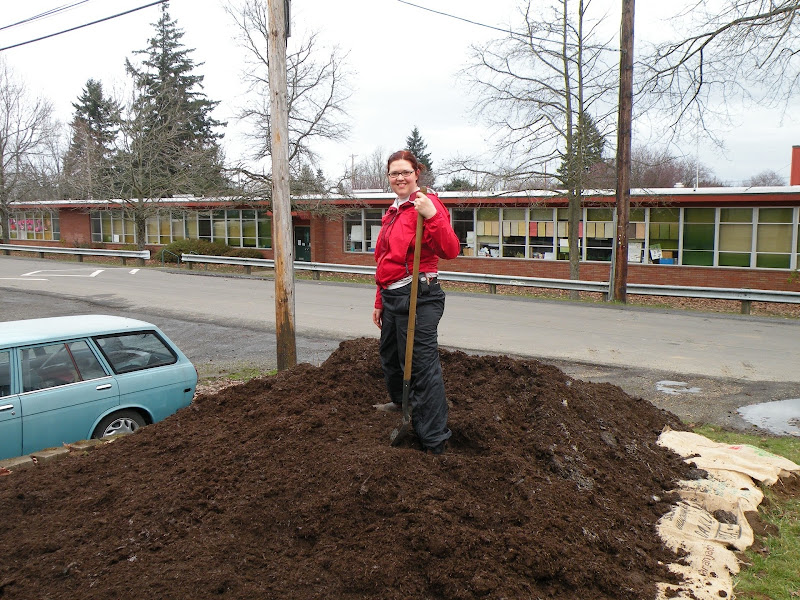
We got 8 cubic yards of mushroom compost from Mt. Scott Fuel Co., which is close to our house, and when we did a quality check it smelled great, and was nice and steamy.
Don’t dive in!
Queen o’ the pile
And...we’re done for now...
But what will the neighbors say? We’ve already seen our neighbors seem less than excited about our new plot. But it doesn’t seem like there are any strong objections, but I’ll happy to talk to any of them if they want to. Our neighborhood doesn’t really feel like the kind of area where our neighbors would be really excited about “strange hippy stuff”, but they probably won’t object too much either.
I think I need to put a sign in the front yard, so when people slow down the stare (already happened when we were working in the yard), they have something to read.
Farmer K has started saying “the more we sow the less you mow”, which is pretty catchy. I also like “America: feeding itself one yard at a time” from Eric. Here are a few more ideas:
It's not a grassroots movement, it's a sunroots movement
Our front yard, seeds of change
Bringing back victory gardens
Mowing is for wussies, real men garden
Friends of sunroot gardens CSA
Plotting (a garden) for change and hope
Garden of eatin'
We're pro bush...bush beans!
Ohh that smell, can't you smell that smell? . . . It's hope
Me and my ho(e) love gardening
This garden'll pop you collar(ed greens)
Food, not lawns
We may also be working on a “Bringing Garden Back” version of “Bringing Sexy Back”
To be continued...

Wednesday, January 14, 2009

I (heart) Carrots and other delicious winter veggies


Look at those colors!! And that’s not even close to the best part...the taste, Ooooh the taste! I’ve been getting lots of delicious carrots from my winter CSA, and I’ve been eating so many of them, my skin might turn orange.
They are so...carroty...sweet and crunchy without the strong parsnip-ish/”nail polish remover” taste and smell from summer commercial carrots. And each kind has a very different flavor, some are sweeter, some are crunchier, some are spicy, some are a little sour (in a nice way), some are buttery. Oh winter carrot!

Tuesday, September 23, 2008

Pacific Northwest Blueberry Bonanza, Urban Gleaning, and other almost free food

Jam! Cobbler! Smoothies! Muffins! Blueberry Bites!

We found a U-Pick blueberry place (orchard?) in far South East Portland, spent an hour picking, and got 10 pounds of blueberries, $1/pound.

They were so tasty! I made 5 half-pints of jam (my first attempt at jam, no pectin, using agave not sugar), and ate the rest of them.

They were so good, that we went back a few weeks later, and got 15 pounds! These had much more blueberry-ness, they were riper (some too ripe), and made sweeter, more jam-y jam (6 half-pints, I used honey to sweeten the jam, 1:5 honey to berry ratio). The rest of the berries I froze for the winter, for making smoothies. They are certainly cheaper, and much tastier that store-bought blueberries.

This year I also got free walnuts from someone Eric works with. They needed to be shelled, but they are very tasty, much more tender than store bought. We’re getting plums from the same friend, and I’m really excited. I tried doing some Urban Gleaning this year, but didn’t have enough buddies and only found a few cherry trees and a plum tree by my bus stop. The plums were bitter and didn’t pit well, so I couldn’t freeze or dehydrate them.

Next year, more urban gleaning, and maybe I’ll by an extra freezer to store more extra food.


Tuesday, September 16, 2008

Gardening this season

What’s more local than an urban CSA powered by bike? Growing vegetables in my own backyard! Since moving in to the new house, I’ve transformed the covered trash pit into a compost-rich bountiful 10’ x 7’ garden plot.
When we moved into the new house, there was a covered patio/thing in the backyard, that we believed was a garden plot that was covered and converted to a patio, or just covered for the winter. In early spring I started demolishing the cover, which, I discovered, was rotted, pressure treated plywood covering a rotted wood frame. Underneath the cover was an assortment of trash including broken glass, parts of styrofoam coolers, ash from the fireplaces inside (with parts of burned things like credit cards, rusted nails and pieces of metal), big rocks, broken pots, coils of old cable, and decomposing netting. The highlight was a folded up piece of carpet 7’ long, buried 3’ deep, diagonally through the garden.

I was expecting a lot of produce from my CSA, so I just planted a few things in the relatively small plot. I planted carrots,
Datura
Tomatoes (from Eric’s Mom, from Germany seeds)
And many volunteer plants from the compost: Pumpkins, zucchini, and squash (acorn-like, but some albino and some technicolor).
The zucchini took over the garden, and then the yard. I started making and freezing zucchini cakes (like latkes).
I also planted parsley and basil.
A week ago, I just cleared out half the garden and planted carrots and lacinato kale for a winter crop.
All in all, I wish I had more carrots, the zucchini and squash took over too much. And I miss tons of fresh peas. So I have big plans for next year, and I’m looking forward to fresh carrots and kale this winter.